









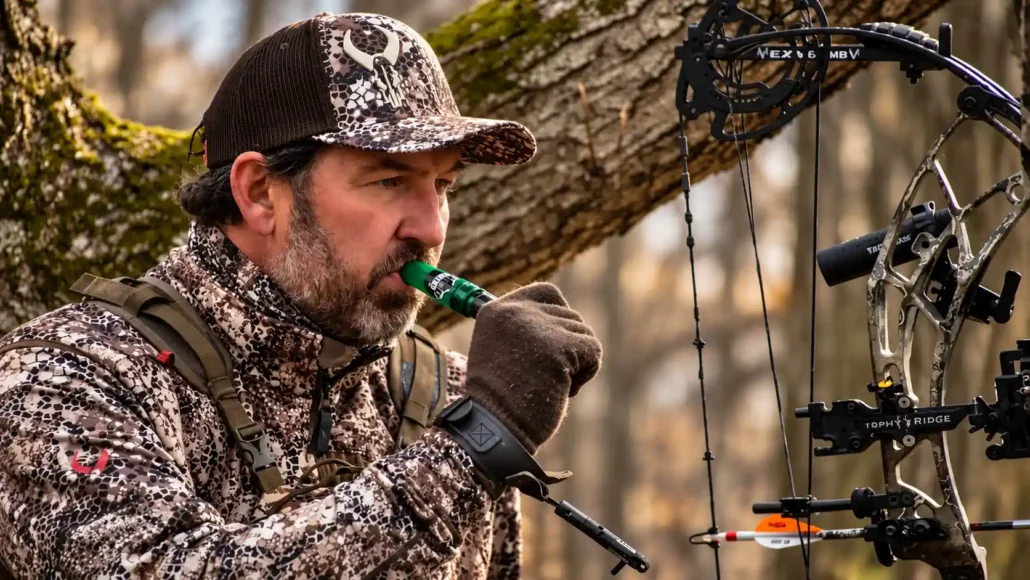
You’ve heard him. Grunting, chasing, crashing through brush, a ridge over. You set up, you call, and nothing. He never shows. Then two days later, the same call pulls a mature buck into range in fifteen minutes. The call didn’t change. The buck did.
Using whitetail calls during the rut works best once you understand why that inconsistency happens in the first place. A University of Wisconsin-Madison and Wisconsin DNR study that GPS-collared 188 bucks over four seasons found that while 2.5-year-old bucks move at consistent, predictable rates throughout the rut, mature bucks 3.5 and older show far more day-to-day variance, some days covering serious ground, others barely moving at all, largely because they’re tied up tending a receptive doe.
A quiet stretch on stand can just as easily mean a mature buck nearby is occupied with a doe out of sight, which is why knowing when to go quiet matters as much as knowing when to call. That’s not a call problem. That’s biology.
Read the Rut Phase Before You Choose a Call
Pre-rut, peak rut, and late rut are not the same hunt, even though they can fall within the same two or three weeks. Pre-rut bucks are curious and testing boundaries, willing to investigate a new sound out of simple interest. Peak rut bucks are locked onto does and short on patience; a call has to compete with an actual doe nearby. Late rut bucks are worn down, more cautious, and less willing to cover distance for a sound that doesn’t feel convincing.
A sound that pulled a response the first week of the rut can get completely ignored the third week, not because the call failed, but because the mood in the woods changed underneath it. Reading which phase you’re actually in matters more than picking the perfect call, which is part of why the Bully Grunt Deer Call’s adjustable O-ring is built to shift tone as the season moves, rather than locking a hunter into one register from October through December.
Match the Call to the Buck’s Mood, Not the Loudest Sound
A cruising buck typically moves in a fairly straight line, nose down testing wind or scrapes rather than lingering, and he’s often your best window to pull off course with a call. A buck already locked onto a doe is far harder to pull away; no call beats a doe he can already see or smell, and you’ll usually see him shadowing her movement instead of traveling independently.
A buck that’s been called at, missed, or pressured earlier in the season gets cautious fast, often stopping to stare, stomping a foot, or angling away rather than closing distance, and an aggressive sequence in that moment can shut him down instead of drawing him in.
More aggressive is not automatically better. Younger bucks and low-pressure areas can tolerate louder, more frequent calling. Mature bucks on hunted ground respond better to something that sounds like a real, single deer, not a performance.
Grunts, Bleats, and Rattling: When Each One Actually Works
Each call plays a different role, and mixing them up costs opportunities.
A short, soft grunt suggests a real deer nearby without demanding a response, and it often gets more attention than a hard, repeated series, which can read as unnatural. Over-grunting educates pressured deer fast. One or two believable grunts, then a pause to let him work, beats constant calling. The Grind’s Bully Grunt Deer Call, with its directional tube and adjustable O-ring, is built for that kind of tunable restraint, from a soft contact grunt to something with more edge, without switching calls.
Doe bleats work as a social cue more than a summons. They suggest opportunity without sounding desperate, and in areas thick with doe traffic, a single well-placed bleat often beats constant rattling, since it fits what a buck already expects to hear.
Rattling should feel like an event, not background noise. It works best when the woods already feel competitive, multiple bucks cruising, visible tension in the air, not as a default opener. Overuse it in a low-competition setting, and it stops sounding like a real fight.
Control Your Distance and Know When to Stop
Loudness should match how far you actually want the sound to travel, not how excited you are. A softer call fits close cover and tight shot windows. A louder sequence makes sense in open terrain where you need to pull attention from farther out, but that same volume in thick timber can feel unnatural and push a cautious buck the wrong direction. A call built with a directional tube, like the Bully Grunt Deer Call, lets you aim sound toward where you expect a buck to be working instead of broadcasting it evenly and hoping the right ears pick it up.
Calling blind into empty woods wastes far more opportunities than it creates. Watch for natural sign first: a buck already working toward you, a doe moving through, fresh rub or scrape activity, before reaching for a call. Once you do call, treat it as a trigger, not a conversation; call once, then stop and watch. If he’s already coming, more calling only gives him more information to second-guess.
Let Your Setup Do Half the Work
A buck can hear a perfectly executed call and still refuse to close the last thirty yards if the setup doesn’t feel safe. Wind direction, approach route, and whether the deer has a believable, unobstructed path to investigate matter as much as the sound itself, since calling from a position that requires him to cross open ground or walk into your wind will cost you a response even when the call was right.
The call creates curiosity. The setup gives him a reason to act.
Quick Rut Calling Framework for Mature Bucks
Identify the rut phase first, since pre-rut curiosity, peak-rut urgency, and late-rut caution each change how a buck is likely to respond to any sound, and calling as if every week of the season is the same wastes an otherwise good setup.
Choose the call that matches the buck’s mood, cruising, locked onto a doe, or already pressured and cautious, because a sound that fits what he’s already feeling gets investigated. In contrast, one that fights his mood gets ignored or avoided entirely.
Use less sound once you’re hunting pressured ground or a buck likely called to before, since over-calling educates deer quickly and a soft, believable sound usually outperforms a loud, repeated sequence once ground has seen real hunting pressure.
Let distance and cover density set your volume and intensity, since a call loud enough to reach across an open field can feel unnatural in thick timber where the same buck is close enough to hear something far softer.
Stop calling once a buck shows genuine interest and starts moving your way, because additional calling at that point mostly gives him more information to second-guess rather than more reason to keep coming.
Save rattling for moments when the woods already feel competitive, multiple bucks cruising or visible tension nearby, since rattling into a quiet setup rarely sounds like a real fight and can do more harm than good.
Why Hunters Trust The Grind for Whitetail Calling
The Grind is veteran-owned and built by hunters who spend their own falls chasing rutting bucks, not just designing gear for other people to use. Every call, including the Bully Grunt Deer Call’s directional tube and adjustable O-ring, is made in the USA and built for realistic field use, not to look good on a shelf.
That focus matters most exactly when conditions get complicated: mature bucks on pressured ground, a shifted rut phase, a mood that calls for restraint instead of volume.
Frequently Asked Questions
When should you use whitetail calls during the rut?
Any phase can work, but timing within the day matters as much as the calendar. GPS-collar research even shows a modest bump in midday movement during the two hottest weeks of the rut, so don’t write off an all-day sit just because dawn and dusk usually get the credit.
Do mature bucks respond better to grunts or bleats?
Neither wins on its own. A practical rule is to lead with a grunt during active movement periods and save bleats for when you’re already seeing consistent doe traffic, since bleats work best as a response to activity already happening nearby rather than a way to create it from nothing.
Does rattling work better during peak rut?
Generally, yes, since peak rut is when real buck competition is most likely, which is exactly when rattling sounds believable. Outside of visibly competitive conditions, rattling more often reads as random noise than a real fight.
Can too much calling scare mature bucks away?
Yes, but a buck that hangs up or turns away after a call isn’t necessarily lost for good. That reaction usually signals it’s time to go quiet rather than call louder, and a buck that felt pushed away can often still be worked later in the sit with patience instead of repeated pressure.
What is the best call for pressured whitetail deer?
On heavily pressured ground, a soft contact grunt typically outperforms rattling or an aggressive sequence, since deer hunted hard usually learn to associate loud, repeated calling with people rather than other deer. The Bully Grunt Deer Call is built around exactly this kind of restraint, giving pressured-ground hunters a subtler option without a second, separate call.
Ready to Call with More Confidence This Season?
Stop guessing at rut timing and start using the right grunt, bleat, or rattling strategy for the mood you’re actually seeing in the woods. Explore The Grind’s whitetail calls and build a smarter rut setup for this season.