









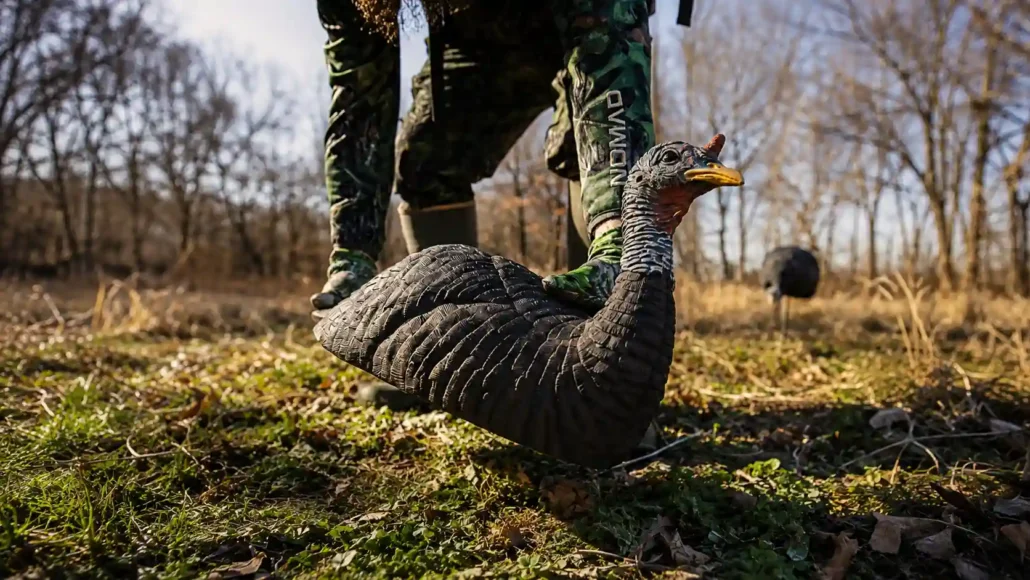
A public-land gobbler doesn’t stay naive for long. By the third or fourth week of season, he’s heard the yelping, seen the decoys, and learned exactly what a hunter’s setup looks like from fifty yards out. That’s the bird you’re actually hunting, not the textbook tom from a how-to video. Turkey decoy strategies for public land have to account for that education, because the same spread that worked in week one can fall flat in week three on the same bird.
You know the feeling. The decoy looks right to you. The angle, the posture, the placement, all of it checks the boxes. And the bird stalls at eighty yards, circles once, and walks off without a sound. That’s not bad luck. That’s a pressured bird reading a setup the way it’s learned to read every setup this season. It’s the same problem our own team runs into hunting public timber every spring, which is why this guide starts with diagnosis, not gear.
Why Public-Land Birds React Differently to Decoys
A bird that’s never seen a decoy investigates out of curiosity. A bird that’s seen a dozen decoys this season investigates out of suspicion. Pressure changes the calculation entirely: what used to be a “perfect” spread, textbook posture, ideal distance, realistic paint, can become the exact profile a wary tom has learned to avoid.
This isn’t about your gear being wrong. It’s about the bird having more data than he did last season. A setup that reads as natural to a naive bird can read as staged to one that’s circled a dozen identical spreads already. It’s the same bird our team runs into chasing public-land birds ourselves each spring, not a naive one.
The Biggest Decoy Mistake Is Making It Too Easy to See
Long visibility feels like an advantage. It isn’t always one. When a pressured tom spots your decoy from two hundred yards out, he has the entire approach to study it, and studying is exactly what an experienced bird does before committing.
Pressured birds often respond better to a setup they discover late, close enough to react on instinct rather than analyze from a distance. Visibility that seems like a selling point on paper can create hesitation in the field, giving a suspicious bird more time to notice what’s off instead of less.
It’s part of why our decoys lean on realistic, natural feather coloring rather than exaggerated features built to catch a bird’s eye from two hundred yards out.
Match the Decoy Type to the Bird’s Mood
Not every situation calls for the same visual message. Think in terms of commitment level, not which decoy looks most impressive in your hand.
Our Half Strut Jake is built for exactly this kind of flexibility, a lower-pressure presence that works across most of the season without overselling the scene. If you want a more assertive hen presence without going full dominance display, our Bugging Hen Decoy is posed to project that energy while still reading as a hen, not a threat.
Save the full dominance play, a strutting tom decoy like our Reaper Quarter Body Strutter, for when you know a genuinely dominant bird is working the area, since that same setup can push a cautious or subordinate tom away entirely.
Keep Public-Land Decoy Setups Simple Enough to Trust
More decoys doesn’t automatically mean more realism. On pressured ground, a full spread with multiple poses can look staged in a way a single, well-placed hen never does. Simplicity isn’t a compromise here; it’s often the stronger signal. A single, well-placed decoy like the Half Strut Jake often does more work on pressured ground than three decoys competing for the bird’s attention.
There’s a second reason to keep it simple on public land: every decoy in your spread is something another hunter might also see. A smaller, tighter setup is easier to keep track of, easier to control visually, and easier to justify if you need to explain your position to another hunter working the same tract.
Use Terrain to Hide the Decoy Until the Right Moment
A high, visible spot can work, but only if you control the approach. Use brush, terrain folds, and field edges to manage exactly when a bird first sees your setup, not just whether he eventually does.
The goal is a controlled discovery, not an open display. A bird that spots your decoy late, close enough that he’s already committed to investigating, behaves differently than one that’s had two hundred yards to think it over. Let terrain do some of that work for you.
Decide When Motion Helps and When It Hurts
Light, wind-driven motion often reads as natural, since real turkeys aren’t perfectly still. But motion that looks deliberate or repetitive can trip the same suspicion a pressured bird has learned to apply to everything else in the field.
There’s no universal answer here. A gentle sway in a breeze can seal the deal on a cautious bird. The same motion, exaggerated or mechanical-looking, can be the exact detail that makes an experienced tom hang up just out of range. Our decoys are balanced specifically so a light breeze creates natural movement on their own, without needing a motion accessory to fake it. When in doubt on heavily pressured ground, a still decoy is often the safer call.
Pair Decoys With Softer Calling, Not Harder Calling
A strong decoy setup still needs calling discipline behind it. Pressured birds have heard plenty of loud, aggressive calling this season, and matching that energy with an equally loud call sequence can undercut the quieter story your decoy is trying to tell.
Softer, less frequent calling gives your visual setup room to do its job instead of competing with it. We build calls across that full range ourselves, from soft, subtle tones to sharper cutting calls, so backing off the volume doesn’t mean switching to different gear entirely.
If the bird has already committed to investigating the decoy, additional calling often isn’t doing you any favors; it’s just more noise for a wary bird to evaluate.
Watch for the Safety Problem Competitor Articles Barely Mention
Decoys don’t just attract gobblers. They attract other hunters, too, and public land means you’re not the only one in the woods carrying calls and gear. According to the National Wild Turkey Federation’s 10 Commandments of Public Land Turkey Hunting, decoys should be carried in a bag rather than exposed in hand or on a vest, since visible decoy parts can be mistaken for a real bird and risk provoking an accidental shot.
This is the trade-off realistic decoys create: the more convincing the decoy, the more it can fool a human at a distance too, not just a turkey. That’s also why we build dedicated carry gear instead of leaving decoy transport as an afterthought. Treat decoy transport as part of your safety plan, not something you figure out once you’re already in the woods.
Build a Decision Tree for the Bird in Front of You
Every pressured bird gives you information, if you’re watching for it. If a tom comes in aggressive and vocal, a more assertive visual cue can match his energy. If he’s hanging back and cautious, reducing the intensity of your decoy, not adding to it, usually works better.
If a bird hangs up just out of range, change something about visibility or angle before you change anything else. And if a bird seems to ignore the setup entirely, simplify rather than add.
This is exactly the kind of situation the Half Strut Jake, Bugging Hen, and Reaper Strutter are built to cover between them, since each one sends a different signal to the bird in front of you. On pressured ground, simplifying usually outperforms escalating, even though escalating is the more instinctual.
Quick Public-Land Decoy Checklist
Before you commit to a setup, run through a few questions that matter more on pressured ground than they do anywhere else. Is the decoy positioned so it’s visible only once the bird is close enough to react on instinct rather than study the scene from a distance, since visibility timing is often the difference between commitment and hesitation? Is the spread simple enough that it wouldn’t look staged to a bird that’s already seen several similar setups this season, since a single well-placed decoy often outperforms a crowded one on pressured ground?
Does the decoy you chose match the bird’s likely mood rather than just looking the most impressive in your hand, since an overly dominant decoy can push away a cautious or subordinate tom? Is your calling quiet and infrequent enough to support the visual story instead of competing with it, since pressured birds have usually heard plenty of loud calling already this season? Is your setup, and your decoy carry method, safe enough that another hunter working the same tract won’t mistake it for a live bird from a distance?
Every one of these questions gets easier to answer when your gear, from decoy choice to carry method, is built for exactly this kind of pressured hunting.
What Gear Helps You Run Safer, Smarter Public-Land Setups?
The right gear supports the strategy above instead of working against it. A decoy built for quick, quiet setup matters when you need to move fast and get invisible again before a bird closes the distance. And how you carry your gear between spots matters just as much as what you set up once you get there.
Our accessories lineup is built around exactly that kind of field-ready flexibility, from carry solutions to the small details that make adapting mid-hunt easier instead of harder.
Why Hunters Trust The Grind Outdoors for Pressure-Ready Turkey Hunts
We’re a veteran-owned team based in Minden, Louisiana, and we hunt pressured public ground ourselves every spring, which is exactly why this article reads the way it does. Our decoys use a rigid EVA-material body rather than the softer flocked-foam construction common in older decoy designs, holding their posture shape season after season without denting or sagging.
The heat-treated, textured paint process resists scratching and flaking through the kind of run-and-gun handling pressured-land hunting involves, and the two-piece motion stake is built for fast, quiet setup when you’re working a bird that won’t give you much time to get it right. We build gear for hunters who need it to hold up under real pressure, not just look good on a shelf.
Upgrade Your Public-Land Setup
Public-land turkeys see more pressure, more calling, and more decoys than most hunters realize. Building a smarter setup starts with gear shaped by hunters who deal with the same educated birds every season, not one-size-fits-all advice.
Shop turkey decoys and gear built for pressured ground and get set up for the bird you’re actually hunting, not the one in the how-to video.